The diagnostic is fixed-fee and complete in itself. If the number it produces does not justify doing anything about it, that is a useful outcome and the engagement ends there.
What your phone operation forgoes per month, computed from your own records.
Implementation of the ranked remediation, in payback order.
Monitoring, so the number does not quietly drift back.
Fees are 50% on signature, 50% on delivery. Diagnostic pricing reflects current engagement count and rises as the cross-client benchmark dataset grows.
A written report, twelve to sixteen pages. It is built to survive being forwarded to someone with a finance background and read sceptically.
One page. The range, the most-likely value, monthly and annualized, in both revenue and contribution margin. Nothing else on the page.
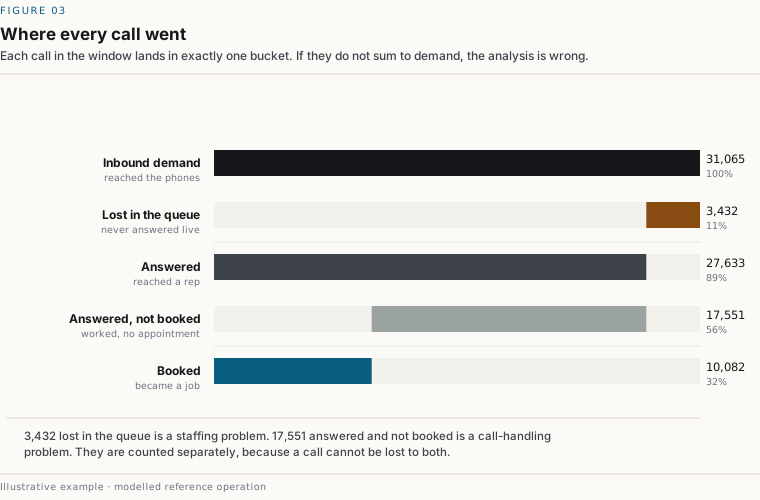
Total inbound demand through answered, through booked, into the three loss buckets, closing against the gap.
Occupancy by day of week and half hour, your abandonment curve with fitted caller patience, and the interval-level staffing gap.
Stage funnel, per-rep variance with the mix normalization shown rather than asserted, and the specific stages carrying the loss.
Separations in the window, fully loaded cost per separation, and the recruiting-versus-ramp asymmetry called out on its own.
Which assumptions drive the spread, ranked, in plain language.
Each fix with implementation cost, modeled monthly impact, payback period, a confidence rating, and what has to happen first.
An honest limitations page. It is the page most likely to earn your trust.
Formulas, fitted parameters, and every assumption with its source classification.
Illustrative, generated from a modelled reference operation.
We send an export checklist written for your specific phone system and field-service software. Most of it is a saved report you already have.
Start time, direction, source, queue wait, talk and hold time, agent, disposition, abandonment flag, and a caller identifier. Caller numbers are hashed the moment they arrive and the raw values are never stored.
Booking records with the originating call id, job type, quoted value, completed value and completion date. The call-to-job link is the piece most operations are missing; we check it before quoting.
Hire and termination dates, pay rate, FTE fraction, and shift schedule or timeclock actuals across the window.
Your contribution margin, and what you pay whoever recruits and coaches CSRs. Both go in the appendix marked as stated by you rather than measured.